...

...
Spread Peace
Showing posts with label my baha'i faith. Show all posts

Monday, November 30, 2015

Rising Place of Rememberance

Mashriqu'l-Adhkar means 'rising place of rememberance', where 'rising place' has connotations of the East and thus of the dawn, and 'remembrance' connotes dhikr and more broadly acts of worship which change our consciousness and being. So the same word is applied appropriately to the radiant heart, the physical building, and meetings for worship, particularly at dawn. Many western communities try in a disultory manner to organize dawn prayers, but few seem able to carry it through consistently. 

From the experience in our own community (South Limburg) it appears that it is difficult to sustain the dawn prayers as simply one activity among all those worthy activities that go with 'being Bahá'í', and that it becomes rather easier when they are understood as one form of the Mashriqu'l-Adhkar and thus as a response to the Aqdas' command:
 "Build ye houses of worship throughout the lands in the name of Him Who is the Lord of all religions" and an integral part - in fact, the central part - of the whole structure of the community. Various kinds of Mashriq meeting are possible: community meetings for prayers and meditation, more experimental liturgies with chanting and the recitation of dhikr, 'firesides' which consist primarily of meditation and chanting and include the answering of questions as these arise, dawn prayers and after-work moments of silence, short lunchtime meetings to say the shorter obligatory prayer and share a smile and some fellowship, longer evening gatherings for the heavy meditation and the long obligatory prayer (see Jackson's book, and also a tablet of Abdu'l-Bahá to the Spiritual Assembly of Bushruyih in Ganjinih Hudud va Ahkam p. 230), 

The meetings of orders of Bahá'í dervishes using particular devotional arts (Memorials of the Faithful p. 38), or meetings for particular liturgical forms (Gregorian morning song, Vespers with 3-part harmony, Arabic chanting, African drumming). Each of these can be called a 'rising place' for praise and thus a Mashriqul-Adhkar, though perhaps the daily morning prayers have a particular priority in relation to the way in which the inspiration derived in the Mashriq is expressed in action during the day (God Passes By, pp. 339-340) and because they are specifically endorsed by Bahá'u'lláh in the Aqdas para 11 5:

Friday, November 20, 2015

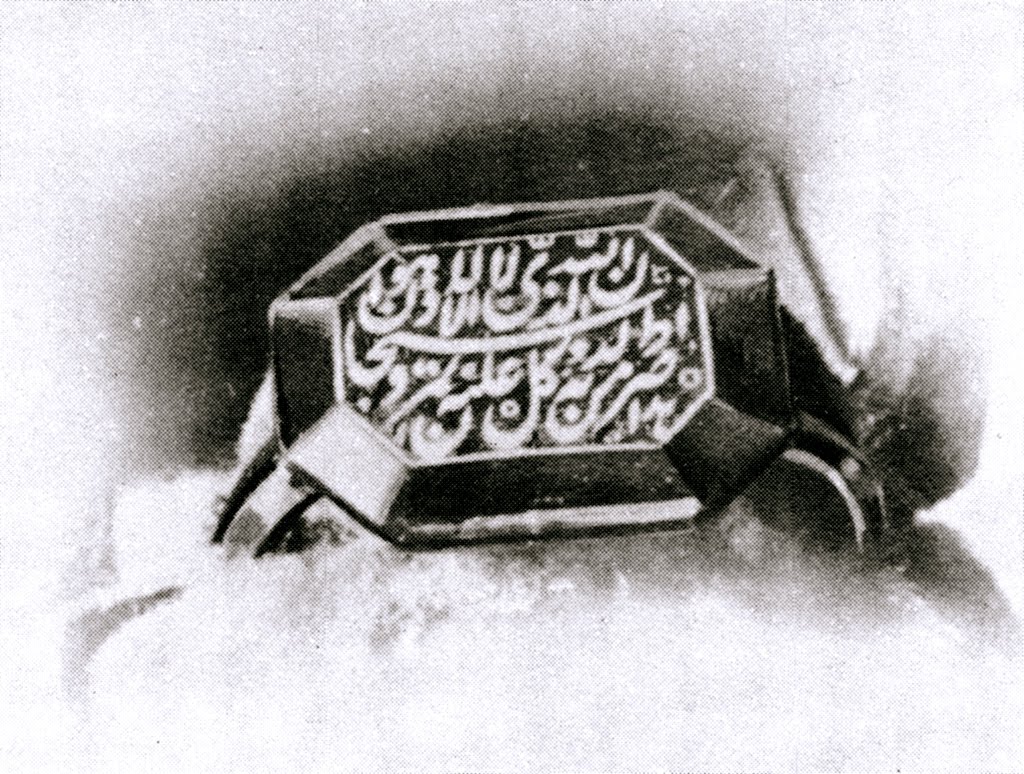
Signet Ring of Abdul Baha

Signet Ring of the Bab
One of those ‘unspiritual people’ was at that moment a member of ‘Abdu’l-Bahá’s party, Dr. Amin Fareed, who had already tried to fraudulently get money out of her [Phoebe Hearst]. It was probably during ‘Abdu’l-Bahá’s stay at the Hearst residence that His signet ring disappeared. That theft and some of other activities of Dr. Fareed were described by Marzieh Gail in her book, “Arches of the Years": 

‘Abdu’l-Bahá’s signet ring disappeared during his Western journey. The Master had confided His loss to Florence and Khan, and named the thief but He did not wish them to speak of it. We in the family always thought that it took place during his stay at the Hacienda … Thereafter the Master signed all his tablets instead of using a seal, capitalizing neither abdu’l nor abbas but only Bahá.

Fareed’s efforts to destroy the Master (who had seen to his education from childhood) make a page of triple darkness … Fareed was capable of whispering to the rich in the United States that although ‘Abdu’l-Bahá needed funds He would not openly accept them, but if they would pass over the money to him, Fareed, he would deliver it to the Master … After returning to the Holy Land ‘Abdu’l-Bahá sent Dr. Baghdadi a Tablet, and directed that copies be distributed to every community so that all could read it. 

The Master wrote here that during His stay in America He had forgiven a certain member of His suite four times, but that He would forgive the man’s misdeeds no longer. ‘Abdu’l-Bahá returned to Haifa, He proceeded directly to the room with 
His wife, Munirih Khanum, and said in a feeble voice, “Dr. Fareed has ground me down!”

(Earl Redman, ‘Abdu’l-Bahá in Their Midst, p. 228)

Wednesday, November 18, 2015

Amatu'l-Baha Ruhiyyih Khanum

Nee Mary Maxwell (1910-2000), also called Ruhyyih Rabbani; daughter of May Bolles Maxwell and Sutherland Maxwell of Montreal, Canada, and wife of Shoghi Effendi, the Guardian of the Baha’i Faith. She served as the Guardian's secretary during his lifetime. 

On 26 March 1952, succeeding her illustrious father, she was appointed a Hand of the Cause of God residing in the Holy Land. Ruhiyyih (meaning "spiritual") is a name given to her by Shoghl Effendi on their marriage. Khanum is a Persian title meaning "lady," "Madame," or "Mrs." The title Amatu’l-Baha (meaning "Maidservant of Bahá”) was used by the Guardian in a cable to a conference in Chicago in 1953. 

Rabbani is a surname given to Shoghi Effendi by 'Abdu'l-Baha After Shoghi Effendi's passing in 1957, she traveled extensively to teach the Baha'i Faith, consolidate Baha'i communities, and serve as a representative of the Universal House of Justice at major events.

Wednesday, October 28, 2015

How To Pray?

Abdu’l-Baha, the role model for Baha’is, traveled to New York early in the 20th century. 

One day he invited an eager follower to his quarters to teach the man to pray.  His guest arrived at 6:00 a.m. and found Abdu’l-Baha deep in prayer at his bedside. He knelt opposite Abdu’l-Baha and began to pray. He ticked off every priority on his prayer list, then he became distracted by cracks in the wall, birds outside, and his aching back. 

After two hours, he finally gazed at Abdu’l-Baha’s face and saw it shining with the radiance of deep communion with the divine. He suddenly longed for a prayer “beyond the murmur of syllables and sounds” as the Baha’i prayers describe this state. 

He longed to feel the sense of devotion he had witnessed. He received an immediate answer to his request, and enjoyed a few moments of exquisite prayer, grateful for this sweet lesson on “how to pray.”

Thursday, August 27, 2015

Solution Through the Use of Prayers

The below five steps were suggested by the beloved Guardian Shoghi Effendi to a believer as a means of finding a solution through the use of prayer.
This statement belongs to the category of statements known as “pilgrims notes”, and as such has no authority, but since it seems to be particularly helpful and clear it was felt that believers should not be deprived of it.

1st Step: Pray and meditate about it. Use the prayers of the Manifestations as they have the greatest power. Then remain in the silence of contemplation for a few minutes.

2nd Step: Arrive at a decision and hold this. This decision is usually born during the contemplation. It may seem almost impossible of accomplishment but if it seems to be as answer to a prayer or a way of solving the problem, then immediately take the next step.

3rd Step: Have determination to carry the decision through. Many fail here. The decision, budding into determination, is blighted and instead becomes a wish or a vague longing. When determination is born, immediately take the next step.

4th Step: Have faith and confidence that the power will flow through you, the right way will appear, the door will open, the right thought, the right message, the right principle, or the right book will be given to you. Have confidence and the right thing will come to your need. Then, as you rise
from prayer, take at once the 5th step.

5th Step: Act as though it had all been answered. Then act with tireless, ceaseless energy. And as you act, you, yourself, will become a magnet, which will attract more power to your being, until you become an unobstructed channel for the Divine power to flow through you.

Many pray but do not remain for the last half of the first step. Some who meditate arrive at a decision, but fail to hold it. Few have the determination to carry the decision through, still fewer have the confidence that the right thing will come to their need.
But how many remember to act as though it had all been answered? How true are these words “Greater than the prayer is the spirit in which it is uttered” and greater than the way it is uttered is the spirit in which it is carried out.
Shoghi Effendi, Principles of Bahá’í Administration, p. 91.

Thursday, August 20, 2015

Days of the Guardian

One evening Shoghi Effendi came over, and he was rather, …, hadn’t been well. He was rather disturbed, badly disturbed, in fact. And he sat down, pushed his plate aside, and Ruhiyyih Khanum said, “Shoghi Effendi, won’t you eat? You haven’t eaten all day. You’re hungry. You’re getting weak. You should eat. And then you can talk to the friends later about your cablegram and the matters you want to talk about.” So he said, well, all right, and he pulled his plate back and the servant gave him some food. He ate one or two mouthfuls, and then he pushed it back and started to talk. Well, Shoghi Effendi, we who lived there got to knew if Shoghi Effendi was well or if he was happy, just your whole life was around that of Shoghi Effendi. And if he was well, you got up in the morning and everything was fine. If he was happy, everything was sunshine. Sometimes you got up in the morning and everything was wrong. Why was it wrong? You didn’t know, but you found out during the day that Shoghi Effendi wasn’t well. So this is when he pushed his plate aside, again without eating, and he started to talk. And he said, “You know, shortly before Bahá’u’lláh passed away, the Master went to see him in Bahji, and He went up to His room and He found His papers all over the floor. So the Master collected them, put them in a neat order, laid them on a divan, and said, Bahá’u’lláh, I collected your papers and put them in order, and I‘ve put them out here so that you can have them. Bahá’u’lláh took them in His hands and threw them all over the floor again and said, “It doesn’t make any difference. It’s all done.” I don’t want to these papers any more. No more papers!” That was said before Bahá’u’lláh passed away. So, he said, when ‘Abdu’l-Bahá, shortly before ‘Abdu’l-Bahá passed away (‘Abdu’l-Bahá was always very meticulous in everything He did), and they found His papers scattered around in His room, and his secretaries collected them and put them in order for Him – put them together – and they took them to ‘Abdu’l-Bahá who took the papers and threw them and said, “I‘m done with the papers. It doesn’t make any difference now. It’s all finished now. I don’t want any more papers.” And shortly after, He passed away.
He said, “I‘m so tired of these papers, I don’t want them anymore. I just don’t want these papers any more. I don't want them.” Well, we talked to Shoghi Effendi and said, “Don’t talk that way! How can you say these things! You are going to kill your friends here.” And I said to Shoghi Effendi, “Why don’t you give these papers to Ruhiyyih Khanum and myself. Give them to us. We‘ll do something with them. We‘ll handle them. We‘ll digest them. We‘ll give you an outline, and so all you have to do is give us the answers, so that if a person raises a question, we‘ll give it to you, and all you have to do is say, “Tell him so-and-so. Tell him so-and-so.” And I said, “Shoghi Effendi, no Guardian of this Cause in the future is going to be able to do what you’re doing. No Guardian can receive all these people and give them personal audiences, give them personal contact and answer personal questions, and deal with the personal problems. I said, they have to in the future deal through the intermediaries. Why don’t you just set up now to have an audience with the pilgrims, one hour in the afternoon. Just one hour. Talk to everyone, have a general talk, and then it’s all finished and you can have a little time, so you can rest a little bit, so you won’t have so many burdens, and you’re not so pressed So I talked along that line and Shoghi Effendi said, “Well, it is not time for any change now.” And that was it.
(In the Days of the Guardian – a Talk by Hand of the Cause of God Leroy Ioas in Johannesburg, South Africa, 1958) ::: source :::

Friday, August 14, 2015

Belief of Orthodox Bahá'ís

1) We are the "true Bahá'ís" We have not altered the true Faith of God. We believe just the same as all Bahá'ís believed before 1957 that the Covenant of Bahá'u'lláh requires obedience to the Guardian of the Cause of God. We believe the present Guardian is Nosrat’u’llah Bahremand.

2) Orthodox Bahá'ís have all of the Institutions of the Cause of God as set forth in the Will and Testament of `Abdu'l-Bahá, including the Hands of the Cause of God, and an international body with the Guardian at its head, the International Bahá'í Council, which is destined in time to become the Universal House of Justice.

3) The Orthodox Baha'is, being under the shade of the Tree of Covenant are divinely guided and blessed. The "table of heaven is prepared" for them, "the angels of heaven" are their "assistants and helpers", and "the life of the Holy Spirit is breathing upon" them (from `Abdu'l-Bahá, Promulgation of Universal Peace, p. 214). 

The Guardian's web page is at www.bahai-guardian.com.

Saturday, August 8, 2015

Bahá’í Calendar Associated with a Lunar Calendar

The friends in the West had always known, through books such as God Passes By and The Dawn-Breakers, that many Bahá’í historical dates were recorded and mentioned based on the lunar calendar of Islam. They had been also aware that a few Bahá’í anniversaries were being observed in some countries in the East in accordance with the lunar calendar, while the rest adhered to the dates of the solar calendar.

The Writings and Utterances of Bahá’u’lláh, such as those published in ‘Gleanings from the Writings of Bahá’u’lláh’, clearly stipulate that Tehran was indeed the “mother of the world,” “the source of the joy of all mankind,” “the holy and shining city” and “the land of resplendent glory.” What other city had been so praised by the Blessed Beauty? It seems Tehran was destined to be the meridian of the future World Order. To an Oriental pilgrim Shoghi Effendi once said that the Prophet Muhammad had called Mecca “the mother of villages,” but Bahá’u’lláh had conferred the title “mother of the world” to His native city.

As to the question of the observances of the Twin Birthdays, as indicated in Note 138 of The Kitáb-i-Aqdas (pages 224–225), what Bahá’u’lláh meant by the two birthdays being as one day (in Questions and Answers #2) was that they should fall on two consecutive days. This is confirmed in a letter written on behalf of the Guardian. To explain fully this provision in the Aqdas, I will quote the following passage from Note 138 mentioned above:

“In the Muslim lunar calendar these [i.e. the anniversaries of the Births of Bahá’u’lláh and the Báb] fall on consecutive days, the birth of Bahá’u’lláh on the second day of the month of Muharram 1233 A.H. (12 November 1817), and the birth of the Báb on the first day of the same month 1235 A.H. (20 October 1819), respectively. They are thus referred to as the ‘Twin Birthdays’ and Bahá’u’lláh states that these two days are accounted as one in the sight of God (Q&A 2).”

Thursday, August 6, 2015

Mullá Husayn: A Student of Siyyid Kázim

Sword of Mulla Husayn
The story of Mullá Husayn begins in the year 1840 in Karbilá, 'Iráq. At the time he had already been a student of Siyyid Kázim for five years. Siyyid Kázim was a teacher of the Qur'án who was preparing the people for the coming of a new Prophet of God.
One day Siyyid Kázim said to his followers, "I wish that one of  you would go to the city of Isfahán, and deliver a message to a great man there named Hájí Siyyid Muhammad Báqir. If one of you can get him to support our teachings, it will greatly help to spread our Cause". Many times Siyyid Kázim repeated this rquest, but no one offered to make the journey.

At this time Mullá Husayn was only twenty-two years old. He was one of the youngest of Siyyid Kázim's students, but certainly one of his best. He sat in Siyyid Kázim's classes quietly and humbly. He was always the last one to arrive before each lecture, and the first one to leave after it was finished. He never stayed after the lecture to ask questions or argue as did many of the others. Ever since childhood he had studied to gain more knowledge--especially about religion and the subject of law.

One day, in 1840, Siyyid Kázim again repeated the question to his students: "Will someone arise and take this Message to Hájí Siyyid Muhammad Báqir in Isfahán?" Still, nobody offered to go, except a man whom Siyyid Kázim did not consider intelligent enough to do it properly. At that moment he turned to Mullá Husayn and said, "You are the one I have chosen. Arise and carry out this mission. With the help of God you will succeed."
Mullá Husayn was filled with joy! He had been too humble to offer himself, but when he was called upon to serve God in this way, he jumped to his feet, kissed the hem of   Siyyid Kázim's coat, and immediately left on his journey to Isfahán.

In a few day' time, Siyyid Kázim received a letter from Mullá Husayn containing the Hájí's declaration of support. When the letter was handed to him, he was lecturing to his followers. However, he read the letter and the declaration to all the men present. He immediately wrote an answer to Mullá Husayn, and also read that to his students. In this letter he praised Mullá Husayn so highly for his service that a few of Siyyid Kázim's followers thought that Mullá Husayn must be the Promised One. The letter was written with such love and tenderness that it was clear that Siyyid Kázim was saying goodby to Mullá Husayn. He knew that he would never see him again on this earth. Siyyid Kázim died on the 31st of December 1843.

It was on the 22nd of January 1844, twenty-two days after the death of Siyyid Kázim, that Mullá Husayn returned to Karbilá. For three days he received visitors at his home, all of whom expressed their sorrow because of the passing of Siyyid Kázim. After listening to their cries he invited the most trusted and outstanding ones to tell him what Siyyid Kázim had told them to do before he died. They told him that Siyyid Kázim had said over and over, "You must leave your homes, travel far and wide, purify your hearts, and search for the Promised One. The only way you can find Him is to search. You must pray to make your hearts pure---and search." Read Full

Thursday, July 30, 2015

Center of the Covenant

Abdu'l-Bahá has received no greater hospitality than that accorded him by the clergy in America.   Pulpits in so many churches have been opened to him that on account of the time it has been possible for him to accept comparatively few of these invitations to address religious congregations.   The doors of various secular societies and associations have also been opened to Abdu'l-Bahá and in many conferences he has voiced the message of the peace of the Covenant of which his life of service is the Center.

Many people have been drawn to Abdu'l-Bahá by a spiritual force which they could not explain; a force which affected them so deeply as to make them observe that a change had been produced in their very souls.   These people are now realizing the reason why Abdu'l-Bahá's presence and words have a spiritual effect that no other man's presence nor words have.   This is because he stands in his mission, quite distinct from other men.   In his life of service to mankind is centered the great power of the Divine covenant.

The Covenant of God has ever been the source of man's spiritual enlightenment in past ages; it is the source of his spiritual enlightenment in this present day, and it will be the source of his spiritual enlightenment during the ages to come. Read Full

Sunday, July 26, 2015

MESSAGES TO THE BAHÁ’Í WORLD


Cablegram of 24 December 1951, reviews "chain of recent historic events heralding long anticipated rise and establishment of the World Administrative Center of the Faith of Bahá’u’lláh in the Holy Land" including among others the "creation of the International Bahá’í Council" and the acquisition of properties in the vicinity of the Báb’s Sepulcher destined to serve as the site of future edifices envisaged by ‘Abdu’l-Bahá to house auxiliary agencies revolving around the twin institutions of the Guardianship and the House of Justice.

" This cablegram also announces the first contingent of twelve Hands of the Cause, including Mason Remey, which he points out "paralleled preliminary measure of the formation of the International Council destined to culminate in the emergence of the Universal House of Justice."  (MESSAGES TO THE BAHÁ’Í WORLD 1950-1957 by Shoghi Effendi).

Tuesday, July 14, 2015

Baha'i Faith and Zoroastrianism

In 19th-century Iran, the founder of the Bahá'í Faith, Bahá'u'lláh, was acclaimed by a significant number of Zoroastrian converts, mainly from Yazd and Kerman, as the promised Sháh Bahrám Varjávand, a Zoroastrian messianic king foretold in several Pahlavi and New Persian texts. Later, still other Zoroastrians, primarily from the Írání Zoroastrian community in India, were won over to the nascent faith. (There were actually few converts from among the Parsis.) Indeed, Zoroastrians were among the first non-Muslim converts to the Bahá'í Faith in its formative era.

Recognition of the advent of this promised saviour depended greatly on one's perception and acceptance of Bahá'u'lláh's fulfilment of Zoroastrian prophecies. This fulfilment was not literal at the level of text, which required certain prodigies to establish prophetic warrant, and had laid out a scenario wherein the Zoroastrian religion and the vanquished Sasanian empire would be restored and the golden age of Zoroastrianism reign triumphant. 

Sháh Bahrám was supposed to be a Zoroastrian warlord, who would fight an apocalyptic battle of cosmic proportions. But Bahá'u'lláh was a prisoner and exile during his forty-year ministry (1852-92). He did not restore Sasanian Iran, nor did he re-establish the Zoroastrian religion. Nor did he reinvest Zoroastrian high priests with their former authority, nor has the golden age of Zoroastrian Iran been revived as the messianic era, the Renovation. A messiah is supposed to be a victor, not a victim. In Judaism, for example, the notion of a crucified messiah was absurd, incredible. (St. Paul calls the idea of a crucified messiah a "scandal" among Jews.) In traditional Zoroastrian terms, an imprisoned messiah was no messiah at all. Drawing from the Jewish ideal of the three highest offices (tria munera), which gave rise to an expectation of three messiahs at the time of John the Baptist (note the three questions addressed to the Baptist in the first chapter of the gospel of John), Bahá'u'lláh was neither a "royal" messiah, nor was he a "priestly" messiah. But was he a "prophetic" messiah? Read More

Monday, July 13, 2015

Kalimat (Words), The Month

Words ( Kalimat) is the standard for the Bahá'í month we are currently honoring, from July 13 until August 1, when the month of Perfection (Kamal) gets the spotlight. Until then, there are a number of things that we may do as Bahá'ís to honor The Báb, Bahá'u'lláh, `Abdu'l-Bahá, and the three Guardians who have all worked so diligently and fearlessly for the propagation of this Most Great Revelation.  
“In the beginning was the Word, and the Word was with God, and the Word was God.” -- Holy Bible, Revised Standard Version, John 1:1 page 103 --  

One may interpret that as saying that the Word was the beginning of all this, this planet,  the several continents, the history of humans with all their false starts and small victories. Words, words, words are in the forefront in this day. We have words flowing incessantly on the Internet, along with Instant Messaging ruling our lives. Words form the bulk of what we are told by the News Media every second of every day. Words, words, words.  Perhaps an overload of words is what we see around us. For better or worse, words  dominate.   


Words are our primary means of expressing ourselves, guided by our individual egos,  cultural upbringing, parental images, and education from the school of hard knocks.  Words can be the source of goodness or evil. Ever since the failings of Adam and Eve introduced, according to Biblical tradition, the element of evil into the world, humans have been on a limited spiritual quest to overcome the evil and replace it with the goodness that God has reflected toward us through His several Manifestations during the Adamic Cycle. We are now in the Bahá'í Cycle and have been given instructions through the twin Manifestations of The Báb and Bahá'u'lláh that will eventually lead us away from the human tendency to elevate ourselves above each other, and attain the peace foretold of old. Read Further

Tuesday, July 7, 2015

Krishna and the Baha'i Faith

The 'Song of God' or Bhagavad-Gita was first given to Arjuna around 1246 B.C. by Krishna. It is considered the 'gospels' of Hinduism. The essence of the teachings of Krishna is this: that we should detach from materialism in order to evolve spiritually. In the Baha'i Faith, we have a similar teaching that we should detach from all save God.

The full teaching to the Indian people are called the Vedas. They constitute six times the bulk of the Bible and recount similar stories and figures; such as the coming of Adam, the flood of Noah, and the missions of Shem and Abraham.
For example, one of the oldest figures in the Vedas was Manu. He was the "progeniter of humanity." His followers were known as the Manus. "According to the Vedas, the Manus represent the earliest Divine Lawgivers, who established sacrificial acts and religious ceremonies." (Encyclopedia of Eastern Philosophy and Religions, pg. 220) An enlightening parallel when compared with the book of Genesis which recounts Adam as the first divine lawgiver. It was Adam who taught his descendants their rituals of sacrifice. This is but one of the numerous parallels that occur throughout the texts of all the world's religions.

There is a relationship between the Vedas to the Holy Bible. In part, this is due to the lineage of Krishna and the Indian people which can be traced back to Adam. Krishna is a descendent of Adam (Manu) through Abraham's third wife Keturah. Moses and the Israelites share a lineage tracing back to Adam through Abraham's first wife Sarah. More importantly, the religions of the Hindus and of the Jews and Christians all originate from the same, Omniscient Creator of the universe. All dissimilarities are due to the tamperings of the clergy classes.

The Hindu texts speak of teachers or prophets that are sent from Brahma (the One True Invisible God). They call them Avatars which means, "an incarnation of divine consciousness on Earth." These teachers have this title because they recieve the "Logos" which is "thought of God." Baha'is refer to these great Avatars as "Manifestations" because they manifest the attributes of God to mankind. They come progressively and teach humanity spiritual truths and reveal laws for an ever advancing civilization. The Vedas speak of 10 Avatars that are to come in this cycle of humanity known as the Adamic cycle which was started with the coming of Adam 6000 years ago.

These Avatars, chronologically, were Adam, Moses, Krishna, Zoroaster, Buddha, Jesus, Mohammed, the Bab and Baha'u'llah. Baha'u'llah was the 9th Avatar (aka - the "reincarnation of Krishna). Baha'u'llah revealed the "New" Song of God for this day. His is the message desperately needed for a demoralized society. The 10th Avatar is called Kalki Avatar; he appears at the end of this cycle or age (now) with his sword drawn for the final destruction of the wicked. What you will find here is Proof that Baha'u'llah truly is the one sent from Brahma. His proof is given from The Holy Bible because we live in a predominately Christian society. If you would like to read the proof for the Kalki Avatar, LINK

The Aghsans and the Afnans

In the Kitab-i-`Ahd, moreover, Baha'u'llah solemnly and explicitly declares: "It is incumbent upon the Aghsan, the Afnan and My kindred to turn, one and all, their faces towards the Most Mighty Branch. Consider that which We have revealed in Our Most Holy Book: `When the ocean of My presence hath ebbed and the Book of My Revelation is ended, turn your faces toward Him Whom God hath purposed, Who hath branched from this Ancient Root.' The object of this sacred verse is none other except the Most Mighty Branch (`Abdu'l-Baha). Thus have We graciously revealed unto you our potent Will, and I am verily the Gracious, the All-Powerful." ... (The World Order of Baha'u'llah, Pages 131-140: gr10)

O my loving friends! After the passing away of this wronged one, it is incumbent upon the Aghsan (Branches), the Afnan (Twigs) of the Sacred Lote-Tree, the Hands (pillars) of the Cause of God and the loved ones of the Abha Beauty to turn unto Shoghi Effendi--the youthful branch branched from the two hallowed and sacred Lote-Trees and the fruit grown from the union of the two offshoots of the Tree of Holiness,--as he is the sign of God, the chosen branch, the guardian of the Cause of God, he unto whom all the Aghsan, the Afnan, the Hands of the Cause of God and His loved ones must turn. He is the expounder of the words of God and after him will succeed the first-born of his lineal descendants. ...(Baha'i World Faith--Selected Writings of Baha'u'llah and `Abdu'l-Baha (`Abdu'l-Baha's Section Only), Pages 438-449: gr10)

Jesus Christ is My Saviour

I believe that Jesus Christ is my Saviour,that He is the Manifestation of God. Does that preclude me from becoming an Orthodox Bahá'í? Perhaps as an Orthodox Bahá'í I will become a better Christian?

I do think that your belief in the Lord Jesus Christ does not preclude you from becoming an Orthodox Bahá'í  and I do believe that it would make you a better Christian.
Before I explain, I want to make sure that you know that you have reached the Orthodox Bahá'ís,  which is a small group of believers and which is not to be confused with the larger group of Bahá'ís whose headquarters presently is in Haifa Israel. Although we have many beliefs in common, we have fundamental religious disagreement with them and our organizations are not the same.

I also want to preface my response that the Orthodox Bahá'ís are not seeking to convert anyone, although we certainly do wish to share what we consider to be uplifting and deeply spiritual teachings and Writings, and a spiritual power that emanates from them, with anyone who is interested about our Faith. I say this because I want to be clear that we do not feel, as many others do, that the circumstance of whether someone accepts or rejects our Faith will enhance or diminish us. The acceptance of the Manifestation of God in every age is a matter between God and the individual.


From my experience and observations, it seems to me that the Writings of His Holiness Bahá'u'lláh, the Manifestation of God for this Day and the Founder of the Bahá'í religion, are keys that unlock the truths contained in the Holy Scriptures of all revealed religions. I have found that to become a true Bahá'í, I first had to become a true Jew, a true Christian, and a true Muslim. M O R E