...

...
Spread Peace
Showing posts with label joel b marangella. Show all posts

Wednesday, January 6, 2016

Perfect Religious Knowledge

     
 The patterns set in motion by biblical religion make the question of religious knowledge of the utmost importance. In essence, mortals have been brought into a state of potential. Everything has been primed in advance: human beings can collaborate with God, to match human actions with God's intention. It is possible to feel the momentum of this idea building; in the biblical outlook individuals can make the decision to let their wills act in unison with that of God, they can stand ready to live in accordance with the whole purpose of history. But how do they do so? How do they know if their actions are correct? How do they know what God's intentions are?

       In trying to answer these questions, the biblical approach begins with a word of caution: no one is ever able to know God completely. No mortal can "become God" in the same sense as can the mystic. No one can claim, "I am God." At best, a human being can only gather information about God, collect insights into the workings of God in history, and on this basis construct what is believed to be a close approximation to God's will. But there is always room for error. Humankind is fallible; anyone can make honest mistakes, they can misjudge. There are, however, two things working in one’s favor: God's steadfast nature and desire to have that fellowship brought about. There is no method that guarantees perfect religious knowledge; individuals must act on trust. Consequently, the first step to such knowledge is the sincere desire and decision to understand God, no matter how imperfect that understanding may be.

Wednesday, December 16, 2015

Who Have Broken the Covenant

Calligraphic arrangement of part of the opening sentence of the Will and Testament of 'Abdu'l-Baha

Some of the writings, prayers and verses of the Blessed Beauty will be mentioned in which association with the violators is forbidden. In the Iranian Commune, He says:

"Protect this Servant from the doubts of the persons who have turned away from Thee and are deprived of the sea of Thy knowledge. O God! O God! Protect this Servant through Thy bounty and generosity from the evil of Thine enemies who have broken Thy Covenant and Testament."

In another place He says: "O My God and the Aim of My Life! Protect this weak one with Thy Mighty hand from the voice of the Naegh."

Also He says: "Ye have taken one whom I hate to be thy beloved, and My enemy to be thy friend."

Also He says: "The company of the wicked ones increaseth sorrow, and the association with the pious ones removeth rust from the heart. The one who desires to associate with God, let him associate with His friends; the one who wishes to hear the Words of God, let him hear the words of His chosen ones."

Also He says: "Do not associate with the wicked, because the company of the wicked changeth the light of life into the fire of remorse. If thou asketh for the bounties of the Holy Spirit, associate with the pure ones, because they have quaffed the eternal chalice from the hands of the Cupbearer of eternity."

Also He says: "The greatest of degradation is to leave the Shadow of God and enter under the shadow of Satan."

Also He says: "O ye servants! There is nothing in this heart save the effulgences of the splendor of the morn of Meeting, and it does not speak but the absolute truth from your Lord. Therefore, do not follow self; break not God's Covenant and violate not His Testament. Proceed with perfect steadfastness, and with heart, soul and tongue, turn unto Him, and be not of the thoughtless."

And still He says: "You have forgotten God's Covenant and violated His Testament."  435 

And again He says: "If anyone comes to you with the book of the wicked, put him behind you."

"Among the people are those who have broken the Covenant, and among them are those who have followed what was ordained by the All-Knower, the All-Wise. My affliction is not from My imprisonment and persecution, or from what comes to Me from My rebellious servants, -- but from the actions of those who attribute themselves to this persecuted One and commit among the people that which is degrading to the honor of God. Verily, they are of the seditious."

Likewise speaking for the violators, He says: "Thou hast made the pulpits for Thy mention, the proclamation of Thy Word and the manifestation of Thy Cause, and we have ascended them to proclaim the breaking of Thy Covenant and Testament."

Likewise, He says: "Take what has been ordained for you and follow not those who have broken God's Covenant and Testament, for lo! they are the people of error."

Again He says: "Those who have broken the Covenant of God, notwithstanding His Commands, and have turned away, they are the people of error before the most Opulent, the Exalted."

And He says: "Those who have been faithful to God's Covenant are of the highest ones in the sight of the exalted Lord. Those who have become negligent are of the people of fire in the sight of Thy Lord, the Beloved, the Independent."

Likewise He says: "Blessed is the servant or maid-servant who believes, and woe to the polytheists who have violated the Covenant of God and His Testament, and deviated from My Right Path."

Likewise He says: "I implore of Thee not to deprive me of what Thou possessest or what Thou hast ordained for Thy chosen ones who have not broken Thy Covenant and Testament. Say! Die with your hatred! Verily, He is come by Whom the pillars of the world have been shaken and because of Whom the feet have stumbled -- save those who have not broken the Covenant, but have followed what God revealed in His Book."

Likewise He says: "The Supreme Concourse will pray for the one who is adorned with the garment of faithfulness between  436  heaven and earth; but he who breaks the Covenant is cursed by heaven and earth."

Likewise He says: "Take hold of what has been revealed unto you, with a power superior to that of the hands of the unbelievers who have violated the Covenant of God and His Testament, and have turned from the Face."

Also He says: "O Yahya! Verily the Book has come! Take it with a power from Us and do not follow those who have broken the Covenant of God and His Testament, and have denied what has been revealed from the Powerful, the All-Knower."

Likewise He says: "I awoke this morning, O My God, under the shadow of Thy great bounty and have taken, with Thy power, the pen to mention Thee with such mention as shall be a light unto the pure, and fire unto the wicked who have violated Thy Covenant, denied Thy Verses and put aside the Kawther of life which appeared by Thy command and was revealed by the finger of Thy will."

(Abdu'l-Baha, Baha'i World Faith - Abdu'l-Baha Section, p. 433)

Monday, November 30, 2015

Rising Place of Rememberance

Mashriqu'l-Adhkar means 'rising place of rememberance', where 'rising place' has connotations of the East and thus of the dawn, and 'remembrance' connotes dhikr and more broadly acts of worship which change our consciousness and being. So the same word is applied appropriately to the radiant heart, the physical building, and meetings for worship, particularly at dawn. Many western communities try in a disultory manner to organize dawn prayers, but few seem able to carry it through consistently. 

From the experience in our own community (South Limburg) it appears that it is difficult to sustain the dawn prayers as simply one activity among all those worthy activities that go with 'being Bahá'í', and that it becomes rather easier when they are understood as one form of the Mashriqu'l-Adhkar and thus as a response to the Aqdas' command:
 "Build ye houses of worship throughout the lands in the name of Him Who is the Lord of all religions" and an integral part - in fact, the central part - of the whole structure of the community. Various kinds of Mashriq meeting are possible: community meetings for prayers and meditation, more experimental liturgies with chanting and the recitation of dhikr, 'firesides' which consist primarily of meditation and chanting and include the answering of questions as these arise, dawn prayers and after-work moments of silence, short lunchtime meetings to say the shorter obligatory prayer and share a smile and some fellowship, longer evening gatherings for the heavy meditation and the long obligatory prayer (see Jackson's book, and also a tablet of Abdu'l-Bahá to the Spiritual Assembly of Bushruyih in Ganjinih Hudud va Ahkam p. 230), 

The meetings of orders of Bahá'í dervishes using particular devotional arts (Memorials of the Faithful p. 38), or meetings for particular liturgical forms (Gregorian morning song, Vespers with 3-part harmony, Arabic chanting, African drumming). Each of these can be called a 'rising place' for praise and thus a Mashriqul-Adhkar, though perhaps the daily morning prayers have a particular priority in relation to the way in which the inspiration derived in the Mashriq is expressed in action during the day (God Passes By, pp. 339-340) and because they are specifically endorsed by Bahá'u'lláh in the Aqdas para 11 5:

Sunday, November 29, 2015

The Immortal Heroine

Marion Jack, "immortal heroine," "shining example to pioneers," passed from this life on March 25, 1954, in Sofia, Bulgaria, where she had been living for twenty-four years as a pioneer of the Baha'i Faith. Her remains are buried in the British cemetery there. The Guardian's tribute, expressed in his cablegram of March 29, attests the high station which this "triumphant soul" has attained.

Marion Jack's services in the Baha'i Faith began early in the new century. Born in Saint John, New Brunswick, Canada, on December 1, 1866, of a prominent family, she received much of her education in England and particularly in France, where she studied art. Landscape painting was her special field. Some of her paintings are preserved in the Holy Land at the World Center of the Faith.

She first learned of the Faith at a social gathering during her student days in Paris. Second guardian, Charles Mason Remey writes of this first introduction :
"My first remembrance of Marion Jack was when we were students in the Latin Quarter in Paris. She was studying painting, I, architecture, and I used to see her in the 'Quarter' along the boulevard on Mont Parnasse. In the Quarter lived a Mme. Philippe who kept a Pension where a number of girl students lived. Mme. Philippe gave dancing parties at infrequent intervals. It was at one of these affairs, a fancy dress dance, that I met Marion. She was dressed in a fiery red costume that she had made herself of crinkled tissue paper topped off by an enormous 'Merry Widow' hat decorated with large yellow paper flowers . . . It was as we danced and sat out between dances that I told Marion of the Baha'I Faith. She was, as many were in those early days, afire with the Faith then and there, all at once. Marion met the Baha'is, came to meetings in my studio and elsewhere, and that was the beginning of her belief." Source

Monday, November 23, 2015

Guardian of the Cause of God

O ye the faithful loved ones of ‘Abdu’l-Baha! It is incumbent upon you to take the greatest care of Shoghi Effendi, the twig that hath branched from and the fruit given forth by the two hallowed and Divine Lote-Trees, that no dust of despondency and sorrow may stain his radiant nature, that day by day he may wax greater in happiness, in joy and spirituality, and may grow to become even as a fruitful tree.

For he is, after ‘Abdu’l-Baha, the Guardian of the Cause of God, the Afnan, the Hands (pillars) of the Cause and the beloved of the Lord must obey him and turn unto him. He that obeyeth him not, hath not obeyed God; he that turneth away from him, hath turned away from God and he that denieth him, hath denied the True One. Beware lest anyone falsely interpret these words, and like unto them that have broken the Covenant after the Day of Ascension (of Baha’u’llah) advance a pretext, raise the standard of revolt, wax stubborn and open wide the door of false interpretation. To none is given the right to put forth his own opinion or express his particular conviction. All must seek guidance and turn unto the Center of the Cause and the House of Justice. And he that turneth unto whatsoever else is indeed in grievous error.
‘Abdu’l-Bahá, Will and Testament of `Abdu’l-Bahá, paragraph 54-55

Friday, November 20, 2015

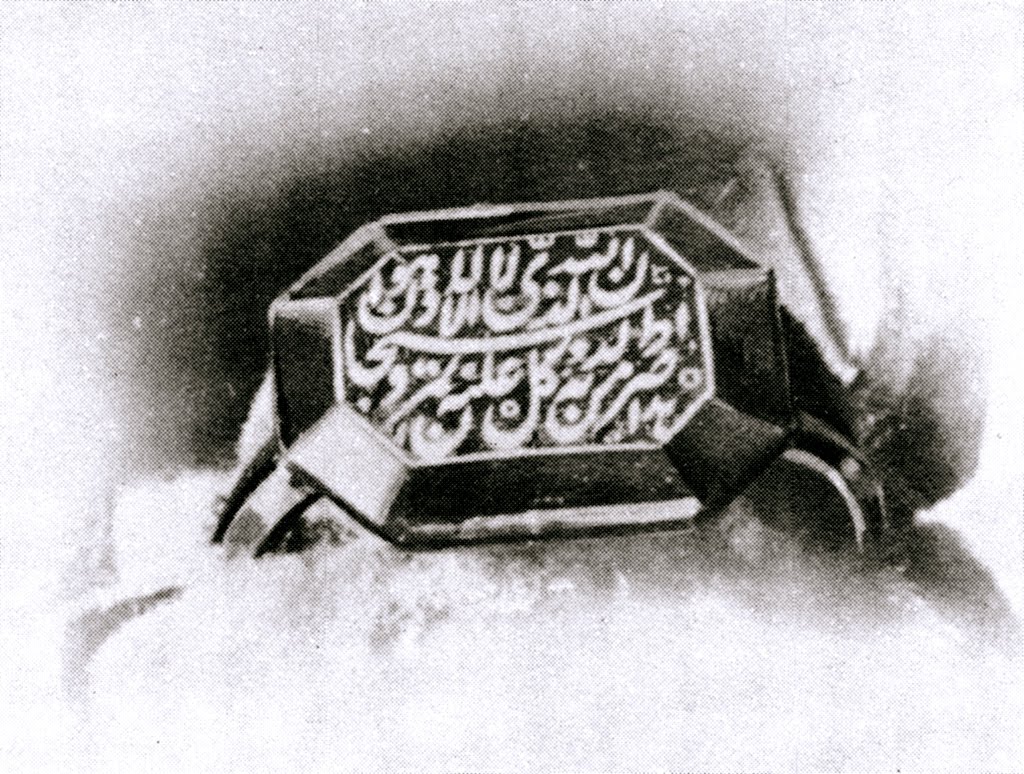
Signet Ring of Abdul Baha

Signet Ring of the Bab
One of those ‘unspiritual people’ was at that moment a member of ‘Abdu’l-Bahá’s party, Dr. Amin Fareed, who had already tried to fraudulently get money out of her [Phoebe Hearst]. It was probably during ‘Abdu’l-Bahá’s stay at the Hearst residence that His signet ring disappeared. That theft and some of other activities of Dr. Fareed were described by Marzieh Gail in her book, “Arches of the Years": 

‘Abdu’l-Bahá’s signet ring disappeared during his Western journey. The Master had confided His loss to Florence and Khan, and named the thief but He did not wish them to speak of it. We in the family always thought that it took place during his stay at the Hacienda … Thereafter the Master signed all his tablets instead of using a seal, capitalizing neither abdu’l nor abbas but only Bahá.

Fareed’s efforts to destroy the Master (who had seen to his education from childhood) make a page of triple darkness … Fareed was capable of whispering to the rich in the United States that although ‘Abdu’l-Bahá needed funds He would not openly accept them, but if they would pass over the money to him, Fareed, he would deliver it to the Master … After returning to the Holy Land ‘Abdu’l-Bahá sent Dr. Baghdadi a Tablet, and directed that copies be distributed to every community so that all could read it. 

The Master wrote here that during His stay in America He had forgiven a certain member of His suite four times, but that He would forgive the man’s misdeeds no longer. ‘Abdu’l-Bahá returned to Haifa, He proceeded directly to the room with 
His wife, Munirih Khanum, and said in a feeble voice, “Dr. Fareed has ground me down!”

(Earl Redman, ‘Abdu’l-Bahá in Their Midst, p. 228)

Wednesday, November 18, 2015

Amatu'l-Baha Ruhiyyih Khanum

Nee Mary Maxwell (1910-2000), also called Ruhyyih Rabbani; daughter of May Bolles Maxwell and Sutherland Maxwell of Montreal, Canada, and wife of Shoghi Effendi, the Guardian of the Baha’i Faith. She served as the Guardian's secretary during his lifetime. 

On 26 March 1952, succeeding her illustrious father, she was appointed a Hand of the Cause of God residing in the Holy Land. Ruhiyyih (meaning "spiritual") is a name given to her by Shoghl Effendi on their marriage. Khanum is a Persian title meaning "lady," "Madame," or "Mrs." The title Amatu’l-Baha (meaning "Maidservant of Bahá”) was used by the Guardian in a cable to a conference in Chicago in 1953. 

Rabbani is a surname given to Shoghi Effendi by 'Abdu'l-Baha After Shoghi Effendi's passing in 1957, she traveled extensively to teach the Baha'i Faith, consolidate Baha'i communities, and serve as a representative of the Universal House of Justice at major events.

Monday, November 16, 2015

Mizra Muhammad-Ali, the Arch-Breaker of the Covenant

[The] arch-breaker of the Covenant of Bahá’u'lláh is Mirza Muhammad-’Ali, the eldest son of Bahá’u'lláh’s second wife Mahd-i-’Ulya. He was born in Baghdad in the first year of Bahá’u'lláh’s arrival there. From the early days of his youth, he found that he could not rise to the level of ‘Abdu’l-Bahá, who was nine years his senior. He lacked those spiritual qualities which distinguished his eldest brother, who became known as the Master from the early days in Baghdad.

The most essential prerequisites for the spiritual survival of all those who were close to Bahá’u'lláh were humility, self-effacement and utter nothingness in His presence. If these qualities were missing in an individual, he would be in great danger of spiritual downfall and eventual extinction.

While ‘Abdu’l-Bahá, the Greatest Holy Leaf, the Purest Branch, and their illustrious mother were all embodiments of servitude and selflessness, Muhammad-’Ali, his brothers and sister, together with their mother, were the opposite. Although the latter group were all sheltered beneath Bahá’u'lláh’s protection, and flourished through the outpouring of His favours, in reality they were the victims of selfish desires and worldly ambitions. During Bahá’u'lláh’s lifetime they were subdued by His authority and kept under control through His admonitions. At the same time, Mirza Muhammad-’Ali and his brothers were the recipients of a great many favours from the believers who, because of their love for Bahá’u'lláh, honoured and revered them too. Thus these three sons acquired an undeserved prestige and basked in the sunshine of their Father’s glory and majesty.

Inwardly, Mirza Muhammad-’Ali was a faithless person, and he led his two younger brothers in the same direction. But outwardly he utilized the power of the Faith and the resources of the community to bolster up his own image in the eyes of the followers of Bahá’u'lláh. He emerged as an important person in the service of his Father by transcribing some of His Tablets and by the use of calligraphy of which he was a master. From the days of his youth he entertained the ambition to occupy a position of eminence within the Faith, a position similar to that of ‘Abdu’l-Bahá, who, from early on, had distinguished Himself among the entire family.

In Muhammad-’Ali’s childhood Bahá’u'lláh conferred upon him the power of utterance, and this became obvious as he grew up. But instead of utilizing this gift to promote the Cause of God, he embarked on a career which hastened his downfall. When he was in his early teens in Adrianople, he composed a series of passages in Arabic and without Bahá’u'lláh’s permission disseminated them among some of the Persian Bahá’ís, introducing them as verses of God which, he claimed, were revealed to him. He intimated to the believers that he was a partner with Bahá’u'lláh in divine Revelation. Several believers in Qazvin were influenced by him and drawn to him.

…In his writings, which are of considerable length, the teen-age Muhammad-’Ali refers to himself, among other things, as ‘the King of the spirit’, calls on the believers to ‘hear the voice of him who has been manifested to man’, admonishes those who deny his verses revealed in his childhood, declares his revelation to be ‘the greatest of God’s revelations’, asserts that ‘all have been created through a word from him’, considers himself to be ‘the greatest divine luminary before whose radiance all other suns pale into insignificance’, and proclaims himself to be ‘the sovereign ruler of all who are in heaven and on earth’.

Such preposterous claims, such a display of personal ambition, evoked the wrath of Bahá’u'lláh, who rebuked him vehemently and chastised him with His own hands.”
Adib Taherzadeh, The Covenant of Baha’u'llah, p. 125

Saturday, November 14, 2015

Paris Talks - 1

Addresses Given by ‘Abdu’l Bahá in 1911

Table of Contents:
                           Part - 1

1.The Duty of Kindness and Sympathy towards Strangers and Foreigners
2.The Power and Value of True Thought Depend upon Its Manifestation in Action
3.God Is the Great Compassionate Physician Who Alone Gives True Healing
4.The Need for Union between the Peoples of the East and West
5.God Comprehends All; He Cannot Be Comprehended
6.The Pitiful Causes of War, and the Duty of Everyone to Strive for Peace
7.The Sun of Truth
8.The Light of Truth Is Now Shining upon the East and the West
9.The Universal Love
10.The Imprisonment of ‘Abdu’lBahá
11.God’s Greatest Gift to Man
12.The Clouds That Obscure the Sun of Truth
13.Religious Prejudices
14.The Benefits of God to Man
15.Beauty and Harmony in Diversity
16.The True Meaning of the Prophecies Concerning the Coming of Christ
17.The Holy Spirit, the Intermediary Power between God and Man
18.The Two Natures in Man
19.Material and Spiritual Progress
20.The Evolution of Matter and Development of the Soul
21.The Spiritual Meetings in Paris
22.The Two Kinds of Light
23.Spiritual Aspiration in the West
24.Lecture Given at a Studio in Paris
25.Bahá’u’lláh
26.Good Ideas Must Be Carried into Action
27.The True Meaning of Baptism by Water and Fire
28.Discourse at “l’Alliance Spiritualiste”
29.The Evolution of the Spirit
30.The Desires and Prayers of ‘Abdu’lBahá
31.Concerning Body, Soul and Spirit
32.The Bahá’ís Must Work with Heart and Soul to Bring About a Better Condition in the World
33.On Calumny
34.There Can Be No True Happiness and Progress without Spirituality
35.Pain and Sorrow
36.The Perfect Human Sentiments and Virtues
37.The Cruel Indifference of People towards the Suffering of Foreign Races
38.We Must Not Be Discouraged by the Smallness of Our Numbers

39.Words Spoken by ‘Abdu’lBahá in Pastor Wagner’s Church (Foyer de l’Ame) in Paris

Friday, November 13, 2015

Ocean Of The Covenant

From the early days of creation down to the present time, throughout all the divine dispensations, such a firm and explicit Covenant hath not been entered upon. 

In view of this fact is it possible for this foam to remain on the surface of the ocean of the Covenant? No, by God! The violators are trampling upon their own dignity, are uprooting their own foundations and are proud at being upheld by flatterers who exert a great effort to shake the faith of feeble souls. 

But this action of theirs is of no consequence; it is a mirage and not water, foam and not the sea, mist and not a cloud, illusion and not reality. 
All this ye shall soon see.                                            Abdul Baha

Saturday, October 31, 2015

Hands of the Cause of God

The Journey Of Mulla Husayn

Mulla Husayn was born in 1813 in Bushruyih in northern Iran. He attended the primary school which was called “maktab” those days. The pupils were taught reading and writing and enough mathematics to know how to add, subtract, and divide. The students also learned how to memorize passages from the Qur’an, in original Arabic, by repetition – without really understanding their meaning and significance. It was considered meritorious to be able to read the words of the Qur’an, especially at the tombs of the dead. 
At the age of twelve, Mulla Husayn finished his studies in his home town of Bushruyih and went to the nearby city of Mashhad, the most prestigious center of religious study in Iran, to pursue his religious studies at a seminary. To be accepted to such religious seminaries one had to show genuine interest and aptitude. These seminaries, known as “madrisih” consisted of some buildings around a courtyard, with pools, wells, and sometimes gardens. Professors and students generally lived at such madrisih’s. There was no fixed course of study. Each professor would teach a subject, while his students would sit on a mat around him. The students would listen, ask questions and discuss their views.
Mulla Husay’s parents, realizing his great spiritual capacities, were happy that their son would follow the path of religion and become a mujtahid,(A Muslim Doctor of Law) thereby honoring the family. But we do not know what was in the mind of the young Mulla Husayn. We do know that, in Mashhad, Mulla Husayn did not bow to the ideas of his professors. Soon he became attracted to the unorthodox ideas of Shaykh Ahmad and became a follower of Shaykh Ahmad’s successor, Siyyid Kazim. He corresponded with the latter, who lived and taught in Iraq, and his desire to meet him grew. Perhaps his heart told him that the Siyyid was more than just a scholar who could teach him the outward laws of religion.
It should be noted that at that time there was much speculation in Iran about the coming of the promised Qa’im – the promised one of the Shi’ih. In towns and villages of Iran, seers and sages called the people to prepare themselves for that great day. There were different expectations as to what things need to happen and how to prepare oneself for that great Advent. Mulla Husayn looked to Siyyid Kazim to unravel this mystery. He decided to journey to Iraq to study with his master.
Since the capital city Tihran is located on the way from Mashhad to Karbala in Iraq, Mulla Husayn stayed there for a while. But while there, he received the news that his father had died in Bushruyih, and he had to return to his native town - now with the responsibility of caring for his four younger sisters and brothers, some of whom were very young. But he would not remain there long as he felt the urge to leave directly for Karbala in Iraq.
While he was preparing to leave, it is reported that Mulla Husayn had a dream. He was in the presence of Muhammad, the Prophet of Islam, who looked at him gently. Muhammad called him to approach and took him in His arms like a kind father. The Prophet then put His lips over those of Mulla Husayn. Suddenly Mulla Husay felt his mouth was filled with so much water that it began to flow out, as if a great ocean had burst forth from his mouth, filling the whole world.
When he awoke, he was perplexed by this dream. But his relatives were certain that it was a sign of great knowledge and attainment in life, that he would obtain the highest rank in the religious hierarchy, would become a great mujtahid (a Muslim Doctor of Law), and would fill the world with his wisdom.
As preparation for departure was underway his family observed a new expression on the face of Mulla Husayn and a mood of rapture about him. The entire family decided to accompany him to Karbala. They sold some of their property in the village and left. Only one of his sisters, Khadijih, who had already married remained at home.
Thus began Mulla Husayn’s journey to Iraq to meet his master Siyyid Kazim, one of the the two forerunners of the Báb. This was 1831 and Mulla Husayn was only 18 years old! 
(Adapted from ‘Mulla Husayn – Disciple at Dawn’, by R. Mehrabkhani)

Wednesday, October 28, 2015

How To Pray?

Abdu’l-Baha, the role model for Baha’is, traveled to New York early in the 20th century. 

One day he invited an eager follower to his quarters to teach the man to pray.  His guest arrived at 6:00 a.m. and found Abdu’l-Baha deep in prayer at his bedside. He knelt opposite Abdu’l-Baha and began to pray. He ticked off every priority on his prayer list, then he became distracted by cracks in the wall, birds outside, and his aching back. 

After two hours, he finally gazed at Abdu’l-Baha’s face and saw it shining with the radiance of deep communion with the divine. He suddenly longed for a prayer “beyond the murmur of syllables and sounds” as the Baha’i prayers describe this state. 

He longed to feel the sense of devotion he had witnessed. He received an immediate answer to his request, and enjoyed a few moments of exquisite prayer, grateful for this sweet lesson on “how to pray.”

Wednesday, September 30, 2015

The Mashrak-el-Azkar of Ishkabad

Washington, D. C.,
October 12, 1908.
To the House of Spirituality of Bahais, 
Chicago, Ill.

Brothers in the service of Abha:-
As you have arisen for the construction of the first Mashrak-el-Azkar in America, and, as I have recently visited Ishkabad and seen there the great Mashrak-el-Azkar of the east, of which we in the west have heard so much, I take it upon myself to write to you a description of this edifice, hoping to share with you the great blessing of meeting with the friends in those parts and of beholding this Temple which is a testimony of their sacrifice and unity.
As you know, Ishkabad is in Russian Turkestan, just north of the Elbruz mountains, which separate the desert plain of western Turkestan, on the north, from Persia on the south. The city itself lies on the plain a short distance from the mountains, which here are quite rugged and rocky. The town is quite modern in aspect, being laid off with gardens and broad streets, which meet at right angles. Rows of trees along the sidewalks remind one of a western city, while the buildings and the waterways, which flank the streets and are fed with water coming from the nearby mountains, are strikingly oriental.
I could hardly believe that this city had sprung up almost entirely during the past half-century. It was but a huddle of mud huts, when Baha'o'llah first directed some of his followers to settle there. Now this is replaced by a large and prosperous city of buildings of brick and stone.
The Mashrak-el-Azkar stands in the center of the city, surrounded by a large garden, which is bounded by four streets. It rises high above the surrounding buildings and trees, its dome being visible for miles, as the traveler approaches the city over the plain. The building in plan is a regular polygon of nine sides. One large doorway and portico, flanked by turrets, facing the direction of the Holy City (Akka), forms the principal motive of the facade, while the dome dominates the whole composition.
The walls of the Temple are of brick covered with a firm and hard stucco, [p. 154] which in that climate resists quite well the action of the elements, while the floors are concrete supported by iron or steel beams.
In plan the building is composed of three sections: the central rotunda, the aisle or ambulatory which surrounds it, and the loggia which surrounds the entire building. Read Full

Tuesday, September 22, 2015

Dawn Prayer

O' my God and my Master!  I am Thy servant and the son of Thy servant.  I have risen from my couch at this dawntide when the Daystar of Thy oneness hath shone forth from the Dayspring of Thy will, and hath shed its radiance upon the whole world, according to what had been ordained in the Books of Thy Decree.
Praise be unto Thee, O my God, that we have wakened to the splendors of the light of Thy knowledge.  Send down, then, upon us, O my Lord, what will enable us to dispense with anyone but Thee, and will rid us of all attachment to aught except Thyself.  Write down, moreover, for me, and for such as are dear to me, and for my kindred, man and woman alike, the good of this world and the world to come.  Keep us safe, then, through Thine unfailing protection, O Thou the Beloved of the entire creation and the Desire of the whole universe, from them whom Thou hast made to be the manifestations of the Evil Whisperer, who whisper in men's breasts.  Potent art Thou to do Thy pleasure.  Thou art, verily, the Almighty, the Help in Peril, the Self-Subsisting.
Bless Thou, O Lord my God, Him Whom Thou hast set over Thy most excellent Titles, and through Whom Thou hast divided between the godly and the wicked, and graciously aid us to do what Thou lovest and desirest.  Bless Thou, moreover, O my God, them Who are Thy Words and Thy Letters, and them who have set their faces towards Thee, and turned unto Thy face, and hearkened to Thy Call.
Thou art, truly, the Lord and King of all men, and art potent over all things.

Sunday, September 13, 2015

Tall, Slender, Graceful - Asiyih Khanum

In about 1832, Baha'u'llah's older sister Sarih married Mirza Mahmud, a son of a minister of the Shah of Persia for the town of Yalrud, which is located near Baha’u’llah’s ancestral place, Takur in the northern province of Mazindaran. Three years later in about October 1835, Baha'u'llah himself, at the age of eighteen, married the sister of Mirza Mahmud, Asiyih Khanum who was then about sixteen years old. She was reported to have been beautiful, kind and caring. Baha’u’llah’s older sister had an active and supporting role in her Brother’s wedding arrangements.

This is how Bahiyyih Khanum, Asiyih Khanum’s daughter, recalled her mother many years later during a conversation with lady Blomfield, a Baha’i from the West who had gone on pilgrimage to Holy Land:

‘I wish you could have seen her as I first remember her, tall, slender, graceful, eyes of a dark blue --a pearl, a flower amongst women . . . 
I have been told that even when very young, her wisdom and intelligence were remarkable. I always think of her In those earliest days of my memory as queenly in her dignity and loveliness, full of consideration for everybody, gentle, of a marvellous unselfishness, no action of hers ever faded to show the loving- kindness of her pure heart; her very presence seemed to make an atmosphere of love and happiness whenever she came, enfolding all comers In the fragrance of gentle courtesy.' 

After the fall from power and death of Baha'u'llah's father in 1839, the family lost their home and Baha'u'llah had to rent a house in the 'Udlajan Quarter of Tehran for His wife, mother and most of His step-mothers and their children. It was here that the couple's surviving children were born (they had seven children in all but only three survived to adulthood). Their eldest surviving son was born in 1844 and was named ‘Abbas after his grandfather but is better known by the title he took later in life as ‘Abdu'l-Baha (the servant of Baha'u'llah). Next in 1846 came a daughter, named Fatimih Sultan Khanum, who in later years was known by the titles Bahiyyih Khanum and the Greatest Holy Leaf, and then in 1850 a son, Mirza Mehdi, who was later given the title the Purest Branch by Baha’u’llah.